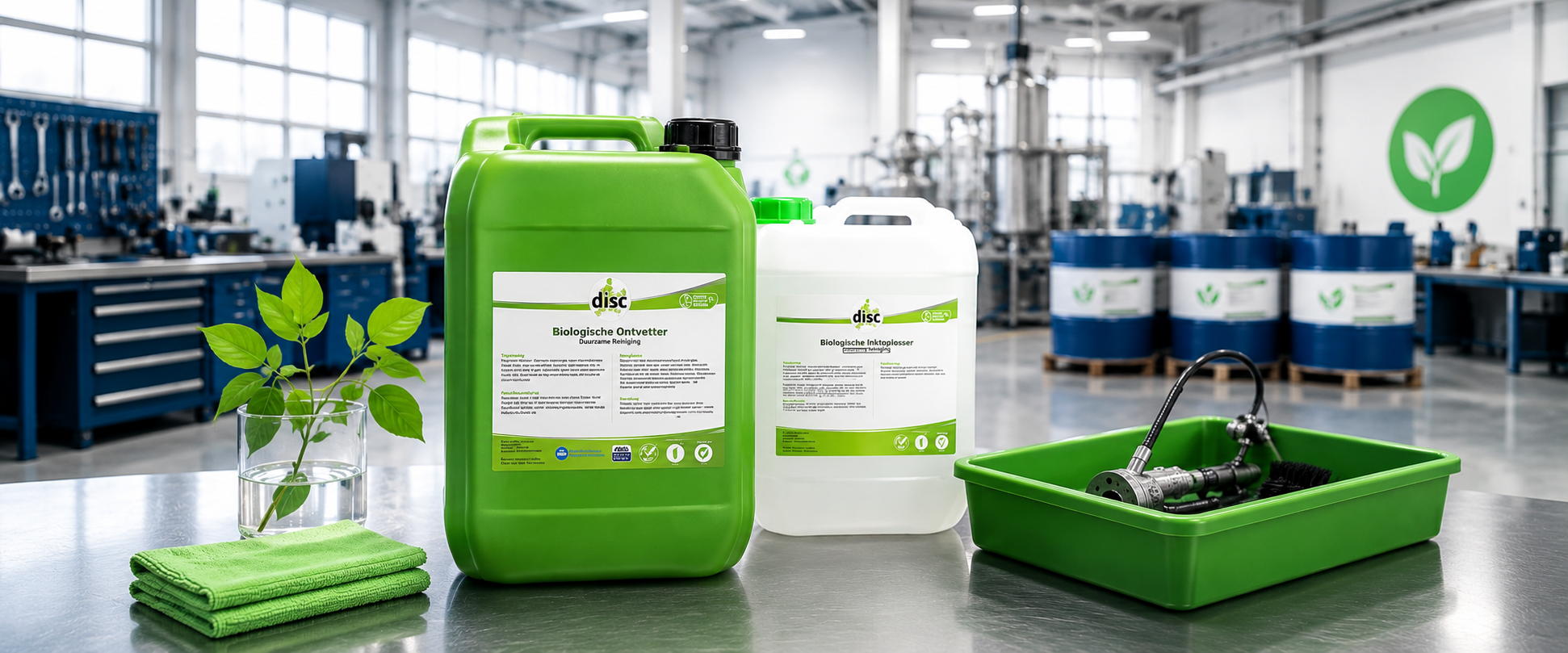

Could the degreasing agent you use daily be putting your employees, your equipment, and the environment at risk? Petroleum-based cleaners are effective, but they leave behind toxic residues, cause harmful VOC (volatile organic compounds) emissions, and create regulatory challenges. Consequently, more and more industrial companies are switching to biodegradable degreasers that clean just as effectively, but without these drawbacks.
The global market for bio-based degreasers is valued at $1.91 billion in 2024 and is projected to reach $3.19 billion by 2033, growing at a CAGR of nearly 6%. This growth is driven by stricter EU regulations, an increasing demand for safer workplaces, and a shift toward more sustainable operations across sectors such as manufacturing, automotive, and food processing.
What Makes a Degreaser Biodegradable?
Biodegradable degreasers are formulated from renewable, plant-based ingredients such as soy oil, citrus extracts, coconut oil, or sugar-based surfactants. These substances break down through natural biological processes without accumulating in soil or waterways.
Traditional solvent-based cleaners leave behind toxic residues. In contrast, a biodegradable degreaser breaks down into water, carbon dioxide, and organic matter, leaving no lasting chemical footprint on the environment.
How Do You Recognize a Truly Biodegradable Degreaser?
Not every product presented as “environmentally friendly” is actually biodegradable. Some products make green marketing claims without meeting recognized standards for biodegradability. Therefore, verify the following points before making a purchase.
Look for independent certifications:
- EU Ecolabel: Confirms that the product meets strict European standards for environmental impact and performance.
- USDA Certified Biobased: Verifies the percentage of renewable, plant-based raw materials in the product.
- EPA Safer Choice: Confirms that the ingredients meet safety criteria for human health and the environment.
Check the Safety Data Sheet (SDS): A genuinely biodegradable product often contains plant-based solvents, biosurfactants, or enzyme-based ingredients instead of petroleum distillates or chlorinated solvents.
Check for biodegradability testing standards: Reliable manufacturers should be able to provide test data based on OECD 301B or OECD 301D standards. Products that achieve at least 60% degradation within 28 days are generally classified as readily biodegradable.
Assess the VOC content: Formulations with low or zero VOCs (Volatile Organic Compounds) are usually safer to use and generate fewer harmful emissions during cleaning.
Be cautious of vague claims: Terms such as “natural”, “green”, or “plant-based” are not regulated on their own. Always request certification documents or independent test data before purchasing.
The Risks of Chemical Degreasers Containing VOCs
Petroleum-based degreasers are widely used because they dissolve grease quickly and perform well in heavy industrial environments. However, regular exposure to certain solvents containing volatile organic compounds (VOCs) can cause health and environmental problems over time.
VOCs evaporate easily at room temperature. As a result, workers can inhale these substances during routine cleaning tasks, even in well-ventilated spaces. Short-term exposure can lead to headaches, dizziness, nausea, and irritation of the eyes, skin, or throat.
Prolonged exposure to specific industrial solvents is linked to serious health risks:
- Cancer: Certain solvents, including benzene and trichloroethylene (TCE), are classified as carcinogens by the International Agency for Research on Cancer (IARC) and are associated with kidney cancer and non-Hodgkin lymphoma, among others.
- Parkinson’s Disease: Research published in JAMA Neurology reported a significantly increased risk of Parkinson’s disease in individuals with long-term exposure to TCE.
- Neurological Effects: Chronic exposure to cleaning agents with high solvent content can contribute to memory problems, cognitive decline, and nerve damage in some workers.
At the same time, not every conventional degreaser carries the same level of risk. The degree of exposure depends on factors such as ventilation, product composition, frequency of use, and the proper application of personal protective equipment (PPE). Many companies still use solvent-based degreasers safely under controlled conditions and in accordance with applicable occupational safety regulations.
Nevertheless, many companies today are transitioning to biodegradable degreasers because they can reduce VOC exposure while maintaining strong cleaning performance in industrial applications.
Key Benefits of Using a Biodegradable Degreaser
- Better for the Environment: Biodegradable degreasers break down naturally without harming aquatic ecosystems. They leave no persistent residues in soil or wastewater and help companies comply with European REACH regulations and VOC emission standards.
- Safe for Workers: Non-toxic, non-corrosive formulas reduce risks to skin and eyes. Low or zero VOC content improves indoor air quality and reduces the need for heavy PPE.
- Simplified Regulatory Compliance: By switching to biodegradable degreasers, you stay ahead of regulations such as EU REACH, CLP, and local VOC emission laws. These products are also eligible for certifications like the EU Ecolabel and Nordic Swan, simplifying sustainable procurement processes in the public sector.
- Powerful Cleaning Performance: Newer enzyme-based formulas clean up to 40% faster than previous generations of bio-based products. They are effective against greases, oils, lubricants, and heavy industrial soils, and can be applied in immersion baths, spray systems, foam applications, and automated cleaning processes.
- Long-Term Cost Savings: Concentrated products reduce packaging waste and lower the cost per application. Additionally, companies can save on hazardous waste disposal, compliance costs, and employee health-related incidents.
- Supports Sustainability Goals: Biodegradable degreasers contribute to ESG reporting, support ISO 14001 certification, and demonstrate a concrete commitment to cleaner business operations.
Where Biodegradable Degreasers Work Best
- Manufacturing and Metalworking: Effectively remove cutting fluids, oils, and lubricants without degrading metal surfaces.
- Food and Beverage Industry: Plant-based formulas are safe for food-contact surfaces and comply with standards such as HACCP and BRC.
- Automotive and Transportation Sector: Effective against engine grease, brake dust, and hydraulic fluids while keeping rubber seals and painted surfaces intact.
- Logistics and Warehousing: Keep forklifts and conveyor systems clean without leaving slippery or corrosive residues.
Key Takeaways
- Biodegradable degreasers break down naturally and leave no toxic residues in soil, air, or water.
- Prolonged exposure to VOCs from conventional degreasers is linked to cancer, Parkinson’s disease, and neurological damage.
- Modern bio-based formulations match the cleaning performance of petroleum-based products.
- Switching reduces regulatory risks, employee health hazards, and long-term operating costs.
- Before purchasing, check for the EU Ecolabel, EPA Safer Choice, or OECD 301 test data.
Conclusion
Switching to a biodegradable degreaser is one of the most practical steps an industrial organization can take today. You benefit from cleaning performance comparable to conventional products while simultaneously achieving gains in worker safety, regulatory compliance, and environmental performance.
As laws and regulations become increasingly strict and sustainability expectations continue to rise, an eco-friendly degreaser is no longer just an attractive option, but a wise business choice. Discover the complete range of biodegradable degreasers from Disc Chemicals and take the step toward cleaner, safer, and more responsible industrial cleaning today.